|
Q1. What is Solaricity?
Solaricity is a term we have coined for solar electricity. It represents the concept of taking your electrical needs from the power of the sun. In one hour, enough energy hits the surface of the earth to power the entire world's energy needs for a whole year. We believe in harnessing that power and not letting it go to waste. Top ↑
Q2. Where do solar panels typically get installed?
Typically, solar panels are installed on a sizable unobstructed roof that faces as close to south (or south-west) as possible. Since each panel is approximately one and a half square meters (approx 15 sq. ft.) in size, the larger the roof the better. microFIT systems come in any number of sizes from one kilowatt for a small system up to as much as ten kilowatts for larger roofs. Top ↑
Q3. How much area will the panels take up on my roof?
With a small one-kilowatt system as mentioned above, the system will take up approximately seven square meters (approx. 75 sq. ft.). A larger system of ten kilowatts can take up as much as seventy-eight square meters (approx. 840 sq. ft.). Knowing the size of your roof is a good first step and will give you a good idea of the size of system Solaricity will likely offer you. A full site assessment will determine the actual available roof space you have to work with. Top ↑
Q4. How many panels will I need to power my home/business?
Today's solar systems are not so much about powering your home or business as much as it is about doing our part to eliminate the need for dirty coal or expensive nuclear power. Technically, the microFIT program turns you into a generator for the province. At Solaricity, we can design a system to meet all or only a portion of your electrical needs or your individual financial situation. With that in mind it is now about how much available sunshine you have and your willingness to invest. Top ↑
Q5. How much does a solar electricity system cost?
Typically a solar electricity system costs on average around $3,500 per kilowatt of generating capacity. As the size of your system increases the cost per watt does come down. This is due to some of the fixed, up-front costs being spread out over the size of the system. To view a list of typical system sizes and associated costs, please check out our products page. Top ↑
Q6. How long will it take to pay off the system?
Depending on the size (and location - see Q7 below) of your system it will take between 6 and 9 years to pay off. The larger the system is, the faster the payback period. This is due to fixed, up-front costs being spread out over a greater capacity, thereby reducing the installed cost per watt. The great thing about investing in a solar system, though, is that, starting with your first revenue cheque, your solar revenue can be reinvested into traditional investments (R.R.S.P.s, G.I.C.s, mutual funds, etc.). Now you have two streams of revenue working for you from your initial investment, one paying you regular cheques from your solar panels and the other earning you interest in the bank. Top ↑
Q7. How much electricity will my system generate?
The amount of electricity any given system will generate 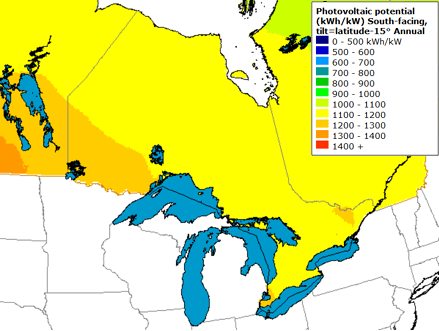 depends on a number of different factors. Things like angle towards the sun, equipment efficiency and shading from trees will all affect potential harvest. According to National Resources Canada, a well designed system with optimum sun exposure has the potential to generate between 1100kWh and 1200kWh per year per kW of capacity installed. Top ↑ depends on a number of different factors. Things like angle towards the sun, equipment efficiency and shading from trees will all affect potential harvest. According to National Resources Canada, a well designed system with optimum sun exposure has the potential to generate between 1100kWh and 1200kWh per year per kW of capacity installed. Top ↑
Q8. Will a solar system affect my property taxes?
The Ontario Minister of Finance has amended regulations under the Assessment Act that will provide clarity as to the treatment of any installed renewable energy systems. The regulation states that small microFiT and other rooftop projects are unaffected by the changes -"The assessment and tax classification of property will not change due to the addition of a renewable energy installation on the rooftop of a building." Other changes that might affect your particular project are indicated by category. Top ↑
Q9. Will a solar system increase my homeowners insurance?
Possibly. Each situation is different and it is recommended that you contact your agent with any specific questions you may have. Top ↑
Q10. What is Ontario domestic content?
As part of the O.P.A.'s Feed-in Tariff program, the rules stipulate that a portion of the hardware and labour be sourced from Ontario. This helps to create greater economic activity in the local economy. The current level of domestic content required for Micro-FIT is 22%. All systems installed by Solaricity meet or exceed this level. Top ↑
Q11. How do I use the electricity from my roof?
You simply turn on your lights, an appliance or television. You sell all of your solar power to the Ontario Power Authority for the appropriate contracted incentive price (39.6¢ per kWh in the case of rooftop solar) for the next 20 years. Any and all power you require for your home continues to be purchased from your existing electricity provider. Through the wonders of technology you will have the first opportunity to buy back your solar power at the price you currently pay for grid power. If your home does not require the power, it is put out onto the grid for your neighbours to purchase and consume. Throughout the night when your panels are not generating electricity, your home continues to maintain its connection to the electricity grid as a supply of available power. This is all done seamlessly and automatically without any intervention or assistance from the homeowner. Top ↑
Q12. Will Solaricity power my home/business during black-outs?
No. For safety reasons, the basic grid-tied system is designed to disconnect from the grid and shut down the supply of energy from the panels. There are battery back-up systems that can be integrated into your home for added comfort and piece of mind during unforeseen power outages. For an on-site evaluation of your needs, please feel free to contact us for a quote. Top ↑
Q13. What maintenance is required for my solar system?
While your system is virtually maintenance free, we do recommend that your panels be cleaned occasionally. If you notice that your system is not performing as it should you can simply wipe down the panels with a damp cloth or mild cleaner that leaves no residue. You can also opt for a service agreement and we will send someone out to test and clean your system on a regular schedule. For more information, please feel free to ask our sales representative at the time of purchase. Top ↑
Q14. Are you licensed and insured?
Absolutely! Our licensed master electrician is a member of the Electrical Safety Authority's Authorized Contractor Program and has almost 40 years of experience in the Ontario electrical industry. We also carry full liability insurance. Lastly, our work is scrutinized and inspected by the E.S.A., your local distribution company and your local building permit office. This gives you peace of mind by ensuring that our work meets all current standards for solar installations. In addition, we are members of the Canadian Solar Industry Association (CanSIA). Top ↑
|